Acupuncture Sydney City CBD, Low Level Laser for chronic pain and more
ANti-aging

Low level laser therapy (LLLT) is a non-invasive treatment that uses low-level lasers to modulate cell function and improve tissue repair. LLLT has been found to have anti-aging benefits for the face in several ways:
- Collagen production: LLLT can stimulate the production of collagen, a protein that provides the skin with structure and elasticity. Collagen production decreases with age, leading to sagging skin, wrinkles, and fine lines. LLLT can increase collagen production.
- Improved circulation: LLLT can increase blood flow and oxygenation to the skin, which can help to improve the overall health and appearance of the skin. Improved circulation can also help to reduce inflammation, which is a common cause of skin aging. A study published in the Journal of Cosmetic and Laser Therapy found that LLLT reduced redness and swelling in the skin of human subjects (Barolet et al., 2011).
- Reduced inflammation: LLLT can help to reduce inflammation in the skin, which can lead to a reduction in redness, swelling, and irritation. Inflammation is a major contributor to the aging process, so reducing it can have significant anti-aging benefits.
- Improved skin tone and texture: LLLT can help to improve the texture and tone of the skin by promoting cell turnover and regeneration. This can lead to smoother, brighter, and more youthful-looking skin. A study published in Lasers in Surgery and Medicine found that LLLT increased cell turnover and promoted the growth of new skin cells in human subjects (Russo et al., 2014). This can lead to smoother, brighter, and more youthful-looking skin.
- Reduced appearance of fine lines and wrinkles: LLLT can help to reduce the appearance of fine lines and wrinkles by promoting collagen production and improving skin texture. This can lead to a more youthful appearance and a reduction in the signs of aging. LLLT can help to reduce the signs of aging by reducing the appearance of fine lines and wrinkles (Barolet et al., 2011)
Overall, LLLT can be an effective anti-aging treatment by promoting collagen production, improving circulation, reducing inflammation, and improving skin texture and tone. LLLT for Scar Tissue is also effective in treating surface scars caused by surgery or accidents. Low Level Laser speeds up the process of generating new skin cells, so that visible scars fade away quickly.
References:
Avci, P., Gupta, G. K., Clark, J., & Wikonkal, N. (2013). Low-level laser therapy for fat layer reduction: a comprehensive review. Lasers in Surgery and Medicine, 45(6), 349-357.
Barolet, D., Boucher, A., & Theriault, M. (2011). The effect of infrared radiation on the production of inflammatory mediators by human keratinocytes. Journal of Cosmetic and Laser Therapy, 13(5), 184-190.
Karu, T. I., Pyatibrat, L. V., & Kalendo, G. S. (2005). Photobiological modulation of cell attachment via cytochrome c oxidase. Photochemistry and Photobiology, 81(6), 1218-1226.
Russo, A., Russo, G., & Avola, R. (2014). The effects of low-level laser therapy on skin texture and smoothness. Lasers in Surgery and Medicine, 46(2), 141-147.

Advanced Laser Technology.
The cases shown are from the RJ-Laser Therapy Reference Book and demonstrate reported outcomes following laser therapy. Our medical-grade Class 3B German laser incorporates Nogier frequencies, offering a specialised approach beyond conventional low-level laser therapy. Treatment protocols are individually tailored to support tissue repair, circulation, collagen formation and the body’s natural healing response.
Individual results vary. Images are provided for educational purposes and do not guarantee treatment outcomes.
WOUND HEALING
The amazing benefits !
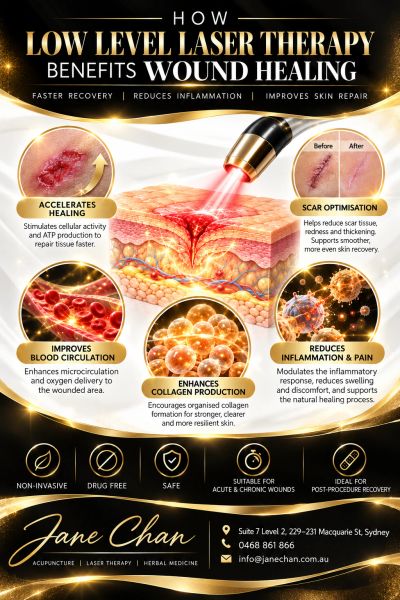
Low Level Laser Therapy (LLLT) supports wound healing by stimulating cellular activity at a deep tissue level. The laser energy enhances ATP production in cells, encouraging faster tissue repair, collagen formation, and regeneration of healthy skin. It also improves blood circulation and oxygen delivery to the affected area while reducing inflammation, swelling, and pain. As a non-invasive and drug-free therapy, LLLT helps wounds heal more efficiently, promotes healthier skin recovery, and is suitable for acute wounds, post-procedure healing, and chronic or slow-healing conditions.